
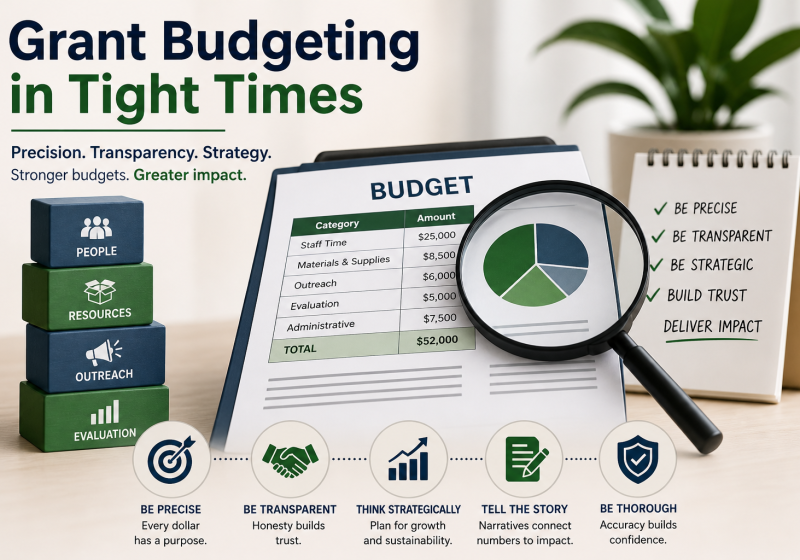
In today’s uncertain funding environment, your budget isn’t just a line item summary—it’s a statement of credibility. Funders want to see exactly how you’ll use their investment and whether your organization can execute with both efficiency and impact.
Be Precise with Every Dollar
Every dollar requested should be clearly linked to your program activities. Avoid vague or padded estimates. Instead, break down costs into understandable categories—staff time, materials, outreach, evaluation—and explain how each one supports your goals.
Transparency is a Trust Builder
Funders aren’t looking for perfection—they’re looking for honesty. If your program needs admin support or overhead coverage, don’t hide it. Justify it. Show how your infrastructure enables your impact. A budget that glosses over real operational needs can raise red flags.
Think Strategically About the Future
Your budget should reflect your organization’s capacity and vision. Want to scale in year two? Include projections. Planning to sustain the program post-grant? Note potential funding sources or earned income strategies. Your budget tells the story of your program’s future—not just its present.
Narratives Bring Numbers to Life
Pair your budget with a strong budget narrative. Use this section to connect the financial dots. Why does this cost matter? How was it calculated? Where will in-kind support come from? A strong narrative transforms your spreadsheet into a funder-friendly roadmap.
Double-Check Everything
Typos, mismatched totals, or inconsistencies between your narrative and numbers can quickly undermine a funder’s confidence.
Final Thought
A strong budget shows you’re serious, prepared, and fundable. In tight times, it might just be the section that makes or breaks your proposal.
P. S. Get introduced to the latest AI technology to write better grants faster, The AI Grant Guide: 10 Steps to Easier and Faster. Value $99 Now $7.
To Your Success,
Linda Peavy
